Reduce the Risk of Diabetic Ketoacidosis (DKA)
Type 1 diabetes continues to be commonly misdiagnosed, especially among adults, approximately 40% of whom experience an initial misdiagnosis.3,4,5
Both lack of diagnosis and poor disease management from misdiagnosis can lead to severe outcomes, including emergency hospitalization as a result of DKA. In fact up to 62% of all patients that are diagnosed with type 1 diabetes without prior screening are suffering from DKA.1,6
Screening can help identify type 1 diabetes before symptoms appear, which may help reduce the risk of DKA at diagnosis.7,8
Additionally, catching T1D early through screening and management,7 can help the body "remember" healthier blood sugar patterns, something known as a favorable metabolic memory.8, 9, 10,11 The damage caused by high blood sugar levels early on can continue to affect the body – even after blood sugar is later brought under better control, so early diagnosis and monitoring may reduce the long-term health risks associated with poor blood sugar control.12
Screening early can also help make a difference in patients' lives, especially as our understanding of T1D expands and advancements are explored.
An in-office or at-home blood test and monitoring of pre-symptomatic T1D patients can help reduce DKA rates at Stage 3 T1D onset by as much as 93.5%.13
-- Calculation: 62% DKA in those without screening - 4% DKA in those with screening = 58% difference. 58% difference / 62% DKA in those with screening = 93.5% reduction from screening.
DKA=diabetic ketoacidosis; T1D=type 1 diabetes.
Sims EK, et al. Diabetes. 2022;71(4):610-623.
Beta cell Function and the Role of C-Peptide in T1D
T1D is an autoimmune condition characterized by the progressive and irreversible loss of beta cells.14,15 Although beta cells are best known for making insulin,16 they also have the vital role of maintaining glucose homeostasis, impacting a range of the body's organs and systems.17 Exogenous insulin cannot mimic the role that beta cells play in maintaining glucose homeostasis.18,19
Ongoing, underlying beta-cell destruction by autoreactive T cells is a critical marker of progressive autoimmune T1D.15,20,21 Beta-cell destruction may begin as early as 4-6 years before clinical symptoms appear.1 But many patients still have some beta-cell function in Stage 3 T1D: beta-cell function decline presents differently and happens at different rates.14, 15
C-peptide is secreted by beta cells at a 1:1 ratio with insulin from proinsulin. It mirrors insulin production, and declining levels indicate loss of beta-cell function.22
Beta-cell function, as measured by C-peptide, can indicate patients' level of remaining beta-cell activity and help determine the extent of autoimmune T1D progression.15 Even residual beta-cell function can reduce risk of T1D complications, including hypoglycemia, retinopathy, nephropathy and neuropathy.9, 19, 23, 24,25 ,26 ,27 ,28 ,29
Read more here about how C-peptide testing can help provide insight for patients with T1D. And visit betawayt1d.com for more information on beta cell function and the role of beta cells in T1D.
C-Peptide is a reliable measure of Beta-cell function compared to insulin.22
Metabolic memory and the long-term impact of T1D
Metabolic memory describes the lasting influence that early metabolic health can have on future outcomes in people with type 1 diabetes. Evidence suggests that exposure to hyperglycemia early in the disease course may induce persistent cellular and molecular changes that continue to influence the risk of long-term complications, even after glycemic control improves.30 Serious, negative, long-term impacts associated with DKA include:
Brain changes and detrimental neurocognitive outcomes31

A sustained negative effect on glycemic control over time, independent of other variables2,32

Increased morbidity and mortality that is associated with lifelong poor glycemic control2

Increased risk for cardiomyopathy in young patients with DKA33

Psychological distress characterized by ongoing, disabling anxiety, intrusive memories of the traumatic DKA event, and secondary depression34
DKA at Diagnosis of T1D Is Associated With Worse Long-Term HbA1C35
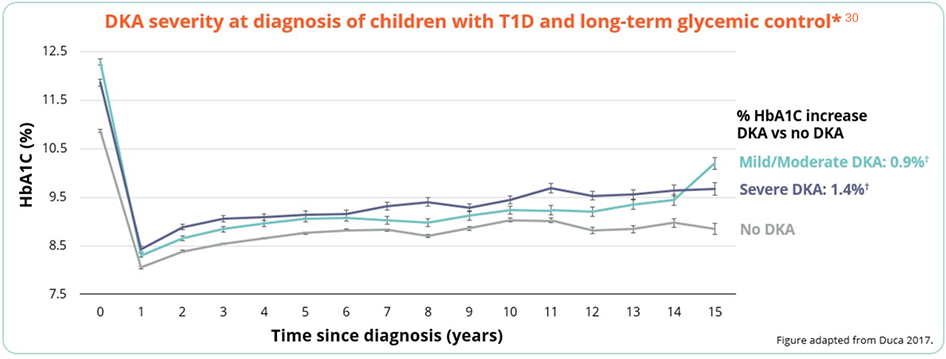
*Based on a prospective cohort study of 3364 Colorado residents diagnosed with T1D before 18 years of age, in 1998–2012, and monitored for up to 15 years. Of those, 1297 (39%) had DKA (defined as blood glucose >250 mg/dL, and venous pH <7.3 or bicarbonate <15 mEq/L) at T1D diagnosis. Severity of DKA available (n=1041) was further classified as mild/moderate (pH 7.10–7.29 or bicarbonate 5–14 mEq/L) (n=693; 67%) or severe (pH <7.10 or bicarbonate <5 mEq/L) (n=348; 33%). †P<0.0001 vs no DKA at diagnosis.24 DKA=diabetic ketoacidosis; HbA1C=hemoglobin A1C; T1D=type 1 diabetes. Duca LM, et al. Diabetes Care. 2017;40(9):1249-1255.

- Diabetes Leadership Council. Type 1 Diabetes Early Detection. Gettingaheadoftype1.org. Published 2025. https://www.gettingaheadoftype1.org/resources/providers
- Duca LM, Reboussin BA, Pihoker C, et al. Diabetic ketoacidosis at diagnosis of type 1 diabetes and glycemic control over time: The SEARCH for diabetes in youth study. Pediatric Diabetes. 2018;20(2):172-179. doi:https://doi.org/10.1111/pedi.12809
- When Type 1 Diabetes Strikes Older Adults. Columbia University Irving Medical Center. Published December 17, 2021. https://www.cuimc.columbia.edu/news/when-type-1-diabetes-strikes-older-adults
- Sweet K. Type 1 diabetes vs. type 2 diabetes. Breakthrough T1D. Published January 6, 2023. https://www.breakthrought1d.org/news-and-updates/type-1-diabetes-vs-type-2-diabetes/
- The Lancet Regional Health – Europe. Misdiagnosis of type 1 and type 2 diabetes in adults. The Lancet Regional Health - Europe. 2023;29(100661). doi:https://doi.org/10.1016/j.lanepe.2023.100661
- Cleveland Clinic. Diabetes-Related Ketoacidosis (DKA). Cleveland Clinic. Published 2024. https://my.clevelandclinic.org/health/diseases/21945-diabetic-ketoacidosis-dka
- Beyond Type 1. Screening for Type 1 Diabetes. Beyond Type 1. https://beyondtype1.org/screening-for-type-1-diabetes/
- Testa R, Bonfigli AR, Prattichizzo F, La Sala L, De Nigris V, Ceriello A. The “Metabolic Memory” Theory and the Early Treatment of Hyperglycemia in Prevention of Diabetic Complications. Nutrients. 2017;9(5):437. doi:https://doi.org/10.3390/nu9050437
- Nathan DM. Realising the long-term promise of insulin therapy: the DCCT/EDIC study. Diabetologia. 2021;64(5):1049-1058. doi:https://doi.org/10.1007/s00125-021-05397-4
- Aiello LP. Diabetic Retinopathy and Other Ocular Findings in the Diabetes Control and Complications Trial/Epidemiology of Diabetes Interventions and Complications Study. Diabetes Care. 2013;37(1):17-23. doi:https://doi.org/10.2337/dc13-2251
- Owens DR. Clinical Evidence for the Earlier Initiation of Insulin Therapy in Type 2 Diabetes. Diabetes Technology & Therapeutics. 2013;15(9):776-785. doi:https://doi.org/10.1089/dia.2013.0081
- Rodriguez-Munoz A, Picon-Cesar MJ, Tinahones FJ, et al. Type 1 diabetes–related distress: current implications in care. Eur J Intern Med. 2024;125:19-27.
- Sims EK, Besser REJ, Dayan C, et al. Screening for Type 1 Diabetes in the General Population: A Status Report and Perspective. Diabetes. 2022;71(4):610-623. doi:https://doi.org/10.2337/dbi20-0054
- Scheiner G, Weiner S, Kruger D, Pettus J. Screening for type 1 diabetes: role of the diabetes care and education specialist. ADCES Pract. 2022;10(5):20-25. doi:https://doi.org/10.1177/2633559x221110216
- Insel RA, Dunne JL, Atkinson MA, et al. Staging presymptomatic type 1 diabetes: a scientific statement of JDRF, the Endocrine Society, and the American Diabetes Association. Diabetes Care. 2015;38(10):1964-1974. https://doi.org/10.2337/dc15-1419
- Type 1 Diabetes TrialNet. T1D Facts. www.trialnet.org. https://www.trialnet.org/t1d-facts
- Podobnik B, Korošak D, Skelin Klemen M, et al. β cells operate collectively to help maintain glucose homeostasis. Biophys J. 2020;118(10):2588-2595. doi:10.1016/j.bpj.2020.04.005
- Laffel LM, Kanapka LG, Beck RW, et al; CGM Intervention in Teens and Young Adults with T1D (CITY) Study Group. Effect of continuous glucose monitoring on glycemic control in adolescents and young adults with type 1 diabetes: a randomized clinical trial. JAMA. 2020;323(23):2388-2396.
- Kramer CK, Retnakaran R, Zinman B. Insulin and insulin analogs as antidiabetic therapy: a perspective from clinical trials. Cell Metab. 2021;33(4):740-747.
- Herold KC, Delong T, Perdigoto AL, Biru N, Brusko TM, Walker LSK. The immunology of type 1 diabetes. Nature Reviews Immunology. 2024;24(6):1-17. doi:https://doi.org/10.1038/s41577-023-00985-4
- Burrack AL, Martinov T, Fife BT. T Cell-Mediated Beta Cell Destruction: Autoimmunity and Alloimmunity in the Context of Type 1 Diabetes. Frontiers in Endocrinology. 2017;8:343. doi:https://doi.org/10.3389/fendo.2017.00343
- Latres E, Greenbaum CJ, Oyaski ML, et al. Evidence for C-peptide as a Validated Surrogate to Predict Clinical Benefits in Trials of Disease-Modifying Therapies for Type 1 Diabetes. Diabetes. 2024;73(6):823-833. doi:https://doi.org/10.2337/dbi23-0012
- Mayo Clinic Staff. Type 1 Diabetes. Mayo Clinic. Published March 27, 2024. https://www.mayoclinic.org/diseases-conditions/type-1-diabetes/symptoms-causes/syc-20353011
- Gubitosi-Klug RA, Braffett BH, Hitt S, et al; DCCT/EDIC Research Group. Residual β cell function in long-term type 1 diabetes associates with reduced incidence of hypoglycemia. J Clin Invest. 2021;131(3):e143011.
- Jeyam A, Colhoun H, McGurnaghan S, et al; SDRNT1BIO Investigators. Clinical impact of residual C-peptide secretion in type 1 diabetes on glycemia and microvascular complications. Diabetes Care. 2021;44(2):390-398.
- Palmer JP, Fleming GA, Greenbaum CJ, et al. C-peptide is the appropriate outcome measure for type 1 diabetes clinical trials to preserve β-cell function: report of an ADA workshop, 21-22 October 2001. Diabetes. 2004;53(1):250-264.
- Lachin JM, McGee P, Palmer JP; DCCT/EDIC Research Group. Impact of C-peptide preservation on metabolic and clinical outcomes in the Diabetes Control and Complications Trial. Diabetes. 2014;63(2):739-748.
- Steffes MW, Sibley S, Jackson M, et al. β-cell function and the development of diabetes-related complications in the diabetes control and complications trial. Diabetes Care. 2003;26(3):832-836.
- Leighton E, Sainsbury CAR, Jones GC. A practical review of C-peptide testing in diabetes. Diabetes Ther. 2017;8(3):475-487.
- Lachin JM, Nathan DM; DCCT/EDIC Research Group. Understanding Metabolic Memory: The Prolonged Influence of Glycemia During the Diabetes Control and Complications Trial (DCCT) on Future Risks of Complications During the Study of the Epidemiology of Diabetes Interventions and Complications (EDIC). Diabetes Care. 2021 Sep 21;44(10):2216–24. doi: 10.2337/dc20-3097. Epub ahead of print. PMID: 34548284; PMCID: PMC8929187.
- Cameron FJ, Scratch SE, Nadebaum C, et al. Neurological Consequences of Diabetic Ketoacidosis at Initial Presentation of Type 1 Diabetes in a Prospective Cohort Study of Children. Diabetes Care. 2014;37(6):1554-1562. doi:https://doi.org/10.2337/dc13-1904
- Muñoz C, Floreen A, Garey C, et al. Misdiagnosis and Diabetic Ketoacidosis at Diagnosis of Type 1 Diabetes: Patient and Caregiver Perspectives. Clinical Diabetes : A Publication of the American Diabetes Association. 2019;37(3):276-281. doi:https://doi.org/10.2337/cd18-0088
- Bonadio W. The Evaluation and Management of Pediatric Diabetic Ketoacidosis: A Comprehensive Review. Clinical Pediatrics. 2022;62(6):000992282211399. doi:https://doi.org/10.1177/00099228221139982
- Moffett MA, Buckingham JC, Baker CR, Hawthorne G, Leech NJ. Patients’ experience of admission to hospital with diabetic ketoacidosis and its psychological impact: an exploratory qualitative study. Practical Diabetes. 2013;30(5):203-207. doi:https://doi.org/10.1002/pdi.1777
- Duca LM, Wang B, Rewers M, Rewers A. Diabetic Ketoacidosis at Diagnosis of Type 1 Diabetes Predicts Poor Long-term Glycemic Control. Diabetes Care. 2017;40(9):1249-1255. doi:https://doi.org/10.2337/dc17-0558
This content was last reviewed in August 2026