Ask patients about family history of T1D and educate about risk factors
Jump to:
Actor Portrayal

Urgent Gaps in Risk Awareness
Patients with just one immediate family member with type 1 diabetes ~15x more likely to develop T1D themselves.1
Despite their elevated risk, individuals with a first-degree family history of T1D are not receiving the information they need about their risk or available screening options. These knowledge gaps matter. Up to 62% of unscreened individuals are diagnosed during diabetic ketoacidosis (DKA), a potentially life-threatening complication.3
A new survey conducted by Beyond Type 1 and commissioned by Sanofi among adults and caregivers of children with a first-degree family member with T1D reveals important opportunities for healthcare providers to strengthen conversations around family history, screening and early risk detection.2
Initiating conversations about elevated family risk before symptoms develop gives patients the information they need to consider screening earlier.
The Family Factor: A T1D Risk Awareness Survey
The 2026 survey of 1,000 US adults included two at-risk audiences: adults ages 18–45 with a first-degree family member living with type 1 diabetes (T1D), and caregivers ages 18–60 of children under age 18 with a first-degree family member living with T1D (see bottom of page for full methodology).2
The findings highlight important gaps that healthcare providers can help address. Even among people with a first-degree family history of T1D, understanding of disease risk and screening remained limited.2
31% of those surveyed are unaware that family history can increase a person's risk of developing T1D2

34% of those surveyed are unaware that T1D is caused by an autoimmune attack on insulin producing beta cells2

While 82% of respondents expressed concern about their or their child's risk of developing T1D, 46% of respondents said they were either not considering autoantibody screening or had not decided if they would within the next six months.2

28% of respondents had never heard of screening2
Opportunity: Patients may not recognize the implications of their own family history. Proactively discussing risk and autoantibody screening can help bridge that gap.
Actor Portrayal

Persistent Misconceptions about T1D Screening
Beyond lack of familial risk awareness and familiarity or confidence in screening, some survey respondents also reported significant misconceptions about T1D as a disease, as well as about accessing T1D screening.
These misconceptions may prevent patients from realizing they are at elevated risk and from seeking screening to begin with. Addressing these misunderstandings during routine conversations can help remove barriers to action.
63% of respondents think the disease is primarily diagnosed in children.2
40% of respondents think living with obesity increases a person’s risk of T1D.2
31% of respondents think autoantibody screening is only available through specialists.2

26% of respondents think autoantibody screening is only possible after symptoms appear.2
Opportunity: Autoantibody screening can be initiated in primary care; addressing these misunderstandings during routine conversations can help remove barriers to action.
Actor Portrayal

Discussing Screening with your Patients
A conversation with a healthcare provider can make the difference between awareness and action. Among respondents who were hesitant about screening, a doctor's recommendation was the strongest motivator to consider screening.2
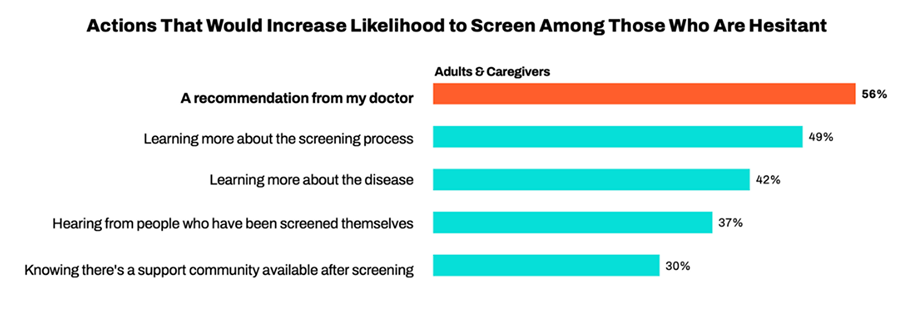
And yet, while 62% of respondents said their doctor has discussed their T1D risk with them, only 28% of respondents familiar with screening reported their doctor initiated a discussion with them about it.2
Opportunity: Conversations about family history and T1D risk are not consistently leading to conversations about screening. Closing that gap could help more at-risk patients understand their options before symptoms develop and potentially avoid severe medical emergencies.
What you can do today

Provide guidance on T1D progression, the autoimmune response that causes the disease, and how to spot it, and potentially improved long term outcomes from early detection.
Help patients make a plan for autoantibody screening before symptoms develop
Click below to download the full survey findings.
This survey was fielded by Ipsos (www.ipsos.com) as an online, 15-minute, self-administered survey among U.S. adults who are at risk of developing type 1 diabetes and caregivers to children under age 18 who are at risk of developing type 1 diabetes between April 1 and May 1, 2026. The national sample included 1,000 U.S. adults and caregivers who met survey qualification criteria. Additional augmented interviews were conducted in six key markets – TX, GA, CA, FL, MA, and NY – to achieve a base size of n=150 each, including a mix of at-risk adults and caregivers. Respondents were recruited from opt-in panels of general population respondents across the country.
To participate as an at-risk adult, respondents had to be ages 18-45 and have a first-degree family member (e.g., a parent, child, or sibling) diagnosed with T1D. To participate as a caregiver, respondents had to be ages 18-60 and be the parent or caregiver of a child who has a first-degree family member diagnosed with T1D. Potential respondents were excluded if they were unwilling to provide informed consent, were not the primary decision maker for their healthcare decisions or if they/their child had previously taken an autoantibody blood test for T1 D. The final sample size for the survey is 1,511, including 511 respondents for the state-level augments, which are not included in the national findings. No weights were applied to either sample, and findings reflect the opinions of these respondents only.
This survey was commissioned by Sanofi.
- Greenbaum, C., VanBuecken, D. & Lord, S. Disease-Modifying Therapies in Type 1 Diabetes: A Look into the Future of Diabetes Practice. Drugs 79, 43–61 (2019).
- Beyond Type 1. The Family Factor: A T1D Risk Awareness Survey. Commissioned by Sanofi; July 2026.
- Diabetes Leadership Council. Type 1 Diabetes Early Detection. Gettingaheadoftype1.org. Published 2025. https://www.gettingaheadoftype1.org/resources/providers
This content was last reviewed in August 2026